 Image 1 of 1
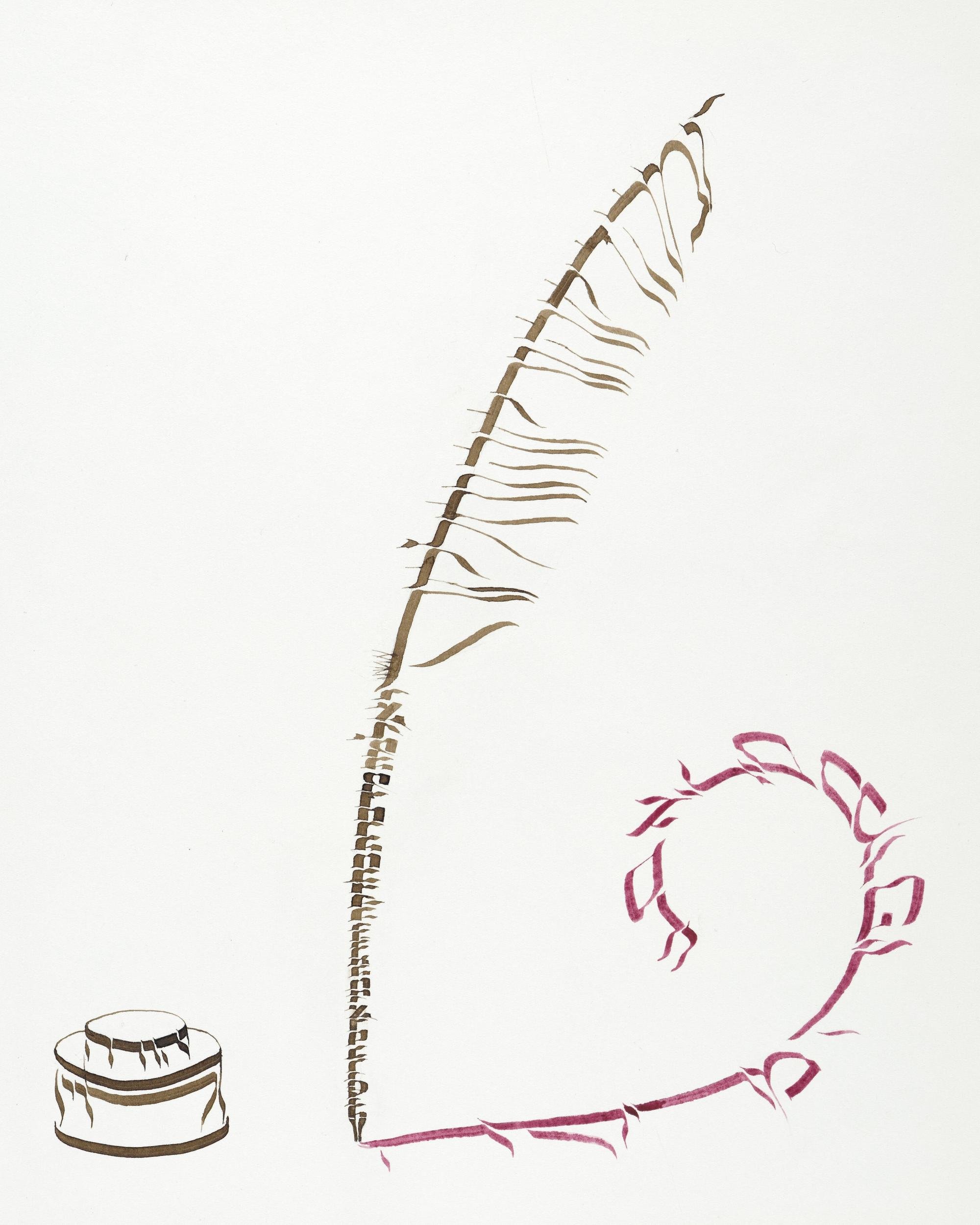
The medieval Hebrew riddle was a sophisticated rhetorical exercise that served not only to flaunt the literary prowess of its author, but also to reflect on the complexities of the divine and natural worlds through linguistic enigma. In “Riddle of the Quill,” I present a classic poem by the philosopher-poet Judah Halevi (c. 1075–1141), structured as a calligraphic carmen figuratum in which the riddle graphically manifests as its own solution. The work uses walnut ink and my personal blend of cochineal ink on cotton rag paper. While the poem can be read as an ode upon the pen’s political power, this piece interprets the “blood of the mighty” (דם אילים, playing on “ram’s blood” ubiquitous in Temple sacrifice) as the hypostasized lifeblood of Jewish thought. The “mighty” are the rabbis of old; their “blood” is the ink of tradition. The quill acts as a silent conduit, as it “pours” tradition from the inkwell of history into the present. The walnut ink transitions into a vibrant cochineal red for the final line, rendering the concept incarnadine incarnate. This bleeding quill represents the act of transmission; the poet’s instrument and muse becomes the vessel through which the Sages’ thoughts are embodied in the physical realm. By rendering Halevi’s name in an inkwell-form cartouche, I position the author not as a detached creator, but as the very source of the fluid medium. The viewer is invited to conceive of the quill not as a mere writing implement, but as a living source of the Eternal.